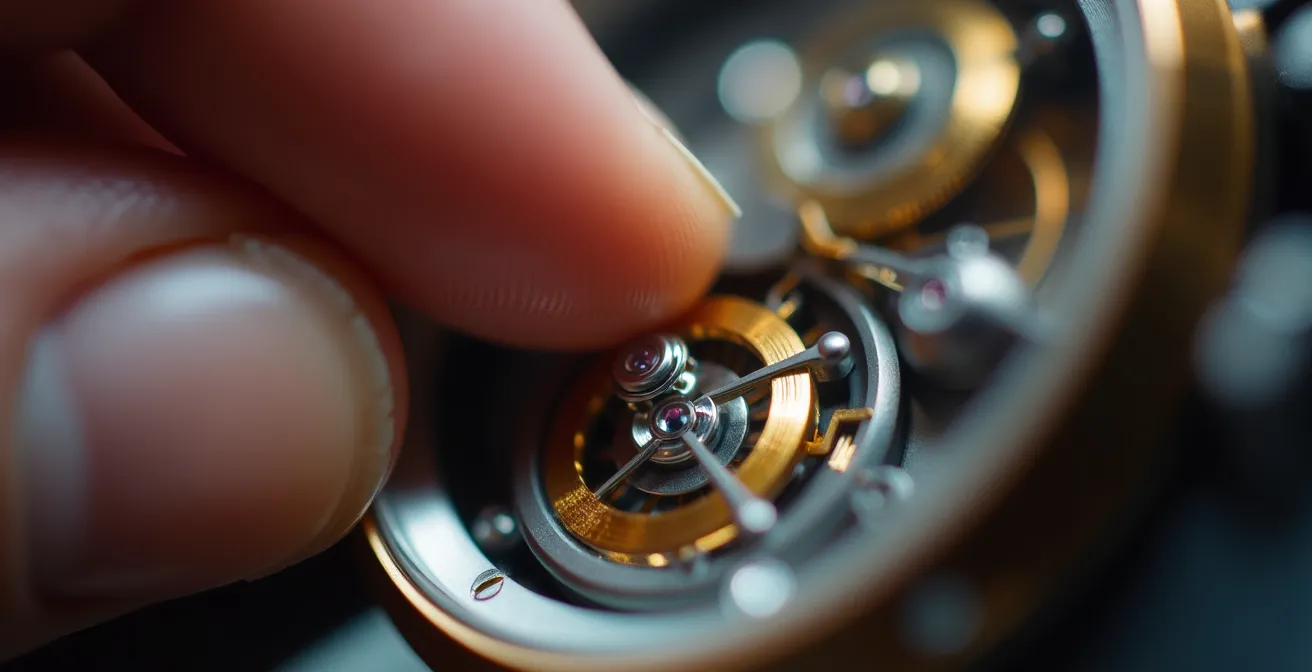
The first time you unscrew a caseback and peer into the mechanical depths of a movement, something shifts. What began as curiosity about gears and springs evolves into something far more profound. The act of dismantling a watch with your own hands initiates a transformation that extends beyond horological knowledge into how you perceive time itself, value craftsmanship, and understand your relationship with mechanical objects.
Most watch enthusiasts begin their journey as consumers, acquiring timepieces based on brand prestige, aesthetic appeal, or investment potential. They read specifications, watch video reviews, and study catalogues. Yet this intellectual approach, however thorough, creates only a surface-level connection. The transformative experience begins when you shift from observer to participant—when your fingertips make direct contact with components measured in fractions of millimeters.
This journey from passive ownership to active engagement mirrors a broader pattern in mechanical appreciation. Platforms like Objectif Horlogerie recognize that true connoisseurship emerges not from accumulation but from understanding. The path traces a specific progression: physical touch awakens tactile knowing, which restructures your perception of time, recalibrates your aesthetic values, triggers existential awareness, and ultimately transforms your identity from consumer to perpetual student.
This transformation unfolds across five distinct stages, each building upon the last. What emerges is not merely technical competence but a fundamental reorientation of how you experience temporality, fragility, and your role as custodian of mechanical heritage.
The Transformative Journey in Brief
- Hands-on disassembly develops tactile knowledge that videos and manuals cannot transmit, creating mechanical empathy through pressure and texture
- Time stops being abstract and becomes visible spatial architecture—seconds as physical distances, gear ratios as three-dimensional relationships
- Value shifts from brand logos to finishing quality, enabling you to recognize excellence across all price points
- Confronting component fragility triggers awareness of impermanence and transforms maintenance into meaningful ritual
- Ownership evolves into stewardship and continuous learning, extending mechanical curiosity beyond watches into all systems
Tactile Understanding Precedes Intellectual Comprehension
Your fingertips possess remarkable sensitivity—capable of detecting surface variations measured in micrometers. When you first attempt to remove a movement from its case or lift a delicate bridge, you encounter resistance, texture, and feedback that no instructional video can convey. This is proprioceptive learning, a distinct epistemological category where knowledge enters through physical sensation rather than visual or linguistic channels.
The pressure required to turn a tiny screw without stripping its head, the subtle resistance indicating proper gear mesh, the specific springiness of a correctly-seated jewel—these sensations build a somatic vocabulary. Your hands learn to recognize click-spring engagement by feel, to sense when a balance wheel pivot is approaching its breaking threshold, to distinguish between the coiled tension of a mainspring at different wind states.
This tactile education operates at tolerances that demand absolute precision. In watchmaking, even a 1 micrometer variation changes the daily rate by 30 minutes, meaning your fingers must develop sensitivity at scales invisible to the naked eye. Manufacturing standards for critical components often demand tolerances under 0.1 micron—thresholds your hands learn to respect through direct contact and, occasionally, through the costly lesson of a broken component.
Neuroscientific Validation of Tactile-Proprioceptive Learning
Research published in Nature Scientific Reports confirms what watchmakers have long understood intuitively: proprioception and tactile sensation create a unique cognitive pathway. The study found that “in conjunction with tactile sensation, proprioception allows us to perform daily manipulation tasks that provide perception and interaction with objects.” This integration of touch and spatial body awareness enables the development of mechanical empathy—the ability to sense component behavior through fingertip feedback before visual confirmation. This explains why even experienced watchmakers who can recite technical specifications still insist on hands-on training: the knowledge pathway through physical manipulation cannot be substituted by intellectual study alone.
Watching disassembly videos creates intellectual knowledge—you understand the sequence, recognize the tools, memorize the steps. But hands-on contact creates muscle memory and mechanical intuition. You learn to calibrate pressure instinctively, to recognize when resistance signals proper alignment versus impending damage, to develop what master watchmakers call “feeling the movement.” This embodied knowledge becomes the foundation for everything that follows.
Essential Tactile Skills for Watch Disassembly
- Develop pressure sensitivity through repeated handling of delicate components
- Learn to recognize proper gear mesh resistance through feel
- Practice identifying spring tension without visual confirmation
- Build muscle memory for screw tension and component seating
Time Reveals Itself as Spatial Choreography
Once your hands have learned mechanical relationships through touch, your mind begins a profound cognitive restructuring. Time stops being an invisible, abstract flow and becomes tangible spatial architecture. You begin to see seconds not as ethereal ticks but as specific physical distances—the precise arc an escape wheel tooth travels before the pallet fork intercepts it.
The gear train transforms from a list of ratios into a frozen dance you can trace with your finger. A 7:1 reduction between the center wheel and third wheel stops being a number and becomes a visible, three-dimensional relationship. You understand that when the center wheel completes one rotation (one hour), the third wheel has spun seven times, and you can see this choreography laid out in space, waiting for the mainspring’s energy to animate it.
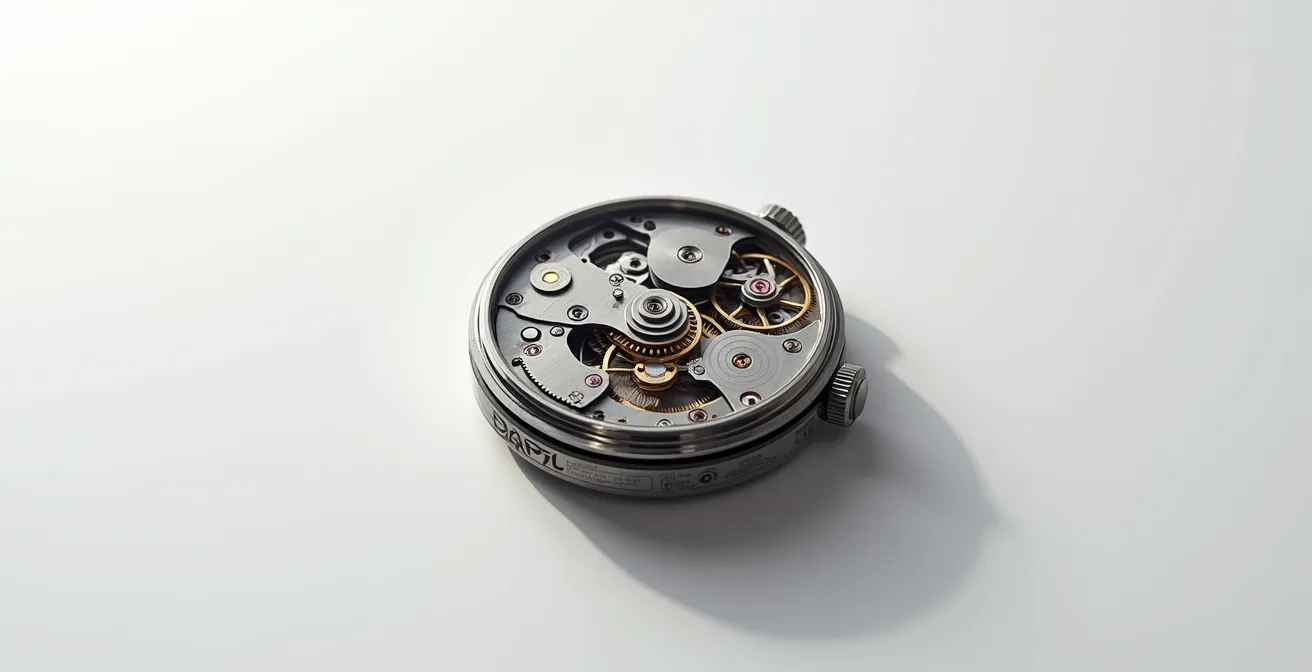
Disassembly reveals time’s three-dimensionality. From the caseback view, you see only the top plate. Once you remove bridges, you discover depth—the vertical stacking of temporal functions. The escapement sits above the gear train, which sits above the mainspring barrel, each layer performing its role in the spatial translation of stored energy into measured intervals. This vertical architecture makes visible what was previously only conceptual.
Beat rate becomes more than an auditory phenomenon. You recognize that 28,800 vibrations per hour versus 21,600 bph manifests visually through escapement geometry and balance wheel amplitude. The faster beat creates smaller oscillations visible in the balance wheel’s arc and the escapement’s more rapid engagement. Hairsprings measuring just 0.03 mm in thickness and weighing less than 2 mg control this oscillation with extraordinary precision, their coiled geometry dictating the tempo of time’s passage.
| Beat Rate | Physical Distance per Tick | Visual Characteristic |
|---|---|---|
| 21,600 bph (3 Hz) | 6 ticks/second | Visible stepping motion |
| 28,800 bph (4 Hz) | 8 ticks/second | Smoother sweep |
| 36,000 bph (5 Hz) | 10 ticks/second | Near-continuous motion |
It serves a single purpose: when it coils and uncoils, it propels the balance wheel which oscillates around its axis. The balance wheel is a flywheel, meant to accumulate the energy provided by the hairspring. Both are made so that this oscillation is as regular as possible in order to become a stably recurring phenomenon. Only then can it become a master clock, a measure of time in very small increments. Wheels and pinions will subsequently convert this into seconds, minutes, hours and so on.
– Worldtempus Editorial, Worldtempus
This spatial understanding of time fundamentally changes your relationship with watches. You no longer see a dial displaying hours and minutes; you see a system of synchronized mechanical relationships converting rotational energy into calibrated intervals. Time becomes something you can touch, trace, and comprehend as physical reality rather than abstract concept.
Movement Finishing Eclipses Brand Prestige
Your new spatial literacy—the ability to see mechanical relationships rather than just components—extends naturally to recognizing finishing quality. Once you’ve dismantled several movements, your eye begins distinguishing between machine-applied decoration and meticulous hand-finishing. This visual education triggers a profound value recalibration that disrupts luxury marketing narratives.
You learn to evaluate anglage sharpness—the crisp, mirror-polished 45-degree bevels along bridge edges that catch light with surgical precision. You recognize perlage depth consistency, noting whether the circular graining maintains uniform spacing and depth across the entire plate or shows irregularities betraying rushed execution. Geneva stripes alignment becomes legible; you see whether the parallel waves flow with geometric perfection or waver with inconsistent spacing.
| Brand Category | Finishing Hours per Watch | Key Techniques |
|---|---|---|
| Independent High-End | 100+ hours | Hand anglage, black polish |
| Patek Philippe/AP | 10-50 hours | Geneva stripes, perlage |
| Mid-range Swiss | 2-5 hours | Machine finishing |
This knowledge creates an egalitarian appreciation that transcends price brackets. A beautifully-finished Seiko or Miyota movement—executed with care despite modest cost—commands intellectual respect that a poorly-regulated luxury caliber cannot match. You begin to recognize excellence wherever it appears, democratizing horological appreciation across all tiers.
Your conversations shift accordingly. Instead of discussing brand acquisition (“I bought a Rolex”), you find yourself studying chronometer-grade regulation tolerances, debating the merits of Côtes de Genève versus circular graining, analyzing the geometry of pallet fork horns. The vocabulary changes from marketing language to craft terminology, from status signaling to technical appreciation.
At the edge of a bridge component, watchmakers have the choice of how to address sharp edges. Rather than leave these bridges with corners, one will typically see a 45-degree bevel. On high-end watches, this is achieved by using a file to first define the profile, and then progressively apply finer and finer abrasives to bring this anglage to a mirror shine. One will often hear collectors describe ‘mirror anglage,’ which is simply a fancy way of denoting highly polished bevels on the edges of bridges. The tops of bridges are usually left with a lower-polish, coarser finish, which means that the anglage helps to accentuate the shape of the movement components through added contrast and three-dimensionality. Typically, the more expensive the watch, the higher the polish on the bevels and the more hand-work is associated with the finishing.
– Analog:Shift Editorial, Analog:Shift
This recalibration liberates you from brand hierarchy. You recognize that finishing quality exists on a spectrum independent of marketing budgets. A watchmaker’s dedication to craft becomes visible in edge bevels and surface treatments, readable to anyone who has trained their eye through hands-on disassembly. The democratization is complete: excellence becomes recognizable across all price points, and your appreciation deepens in proportion to your understanding rather than your expenditure.
Mechanical Fragility Illuminates Human Impermanence
Once you can recognize finishing quality, you simultaneously perceive its delicacy. The mirror-polished anglage you admire exists on components that can crack from a single careless moment. The hairspring that orchestrates time’s passage is an extremely thin, coiled spring measuring just 0.03 mm in thickness—roughly one-third the diameter of a human hair. A slight bend, a magnetic field, a moment of inattention, and perfect timekeeping becomes complete failure.
This confrontation with mechanical vulnerability functions as memento mori. The hairspring becomes a meditation on impermanence—0.12 mm of coiled steel standing between precise chronometry and total breakdown, mirroring the fragile biological systems that sustain human life. You begin to see parallels between lubricating jewels to reduce friction and the self-care required to slow our own entropy. Mechanical empathy becomes self-empathy.
| Component | Vulnerability | Consequence of Damage |
|---|---|---|
| Hairspring | Bending, magnetization | Complete timing failure |
| Balance pivots | Breaking under pressure | Movement stops |
| Jewels | Cracking from impact | Increased friction, wear |
Regular maintenance transforms from chore into ritual—an acknowledgment that all systems, mechanical and biological, require care and eventually wind down. The act of cleaning, lubricating, and regulating a movement becomes a practice of attention and preservation. You accept that entropy is inevitable but can be slowed through diligent care.
The balance spring is an essential component of the watch and one of the most complicated to design because of its thinness, fragility and length.
– Charlie Paris, Charlie Paris Magazine
Breaking a component during disassembly teaches more than successful assembly. It confronts you with irreversibility, forces acceptance of imperfection, and clarifies your limits. The snap of a pivot or the deformation of a hairspring cannot be undone. This encounter with permanent consequence carries philosophical weight—it teaches that some mistakes cannot be reversed, that systems are more fragile than they appear, and that understanding requires accepting the risk of damage.
The relationship between watches and human mortality becomes explicit. Both require regular care, both degrade through use, both eventually succumb to entropy. The rituals of maintenance—cleaning, lubricating, adjusting—become practices of mindfulness, reminding you that preservation requires ongoing attention and that nothing lasts without intervention. Through precious metals in timepieces and delicate mechanisms, you confront the universal truth of impermanence.
Key Takeaways
- Tactile disassembly creates proprioceptive knowledge distinct from intellectual understanding, building mechanical empathy through touch
- Time transforms from abstract concept to visible spatial architecture measurable in physical distances and gear ratios
- Value shifts from brand prestige to finishing quality, democratizing appreciation across all price tiers
- Component fragility serves as memento mori, transforming maintenance into ritual acknowledgment of impermanence
- Ownership evolves into stewardship and perpetual apprenticeship, extending curiosity beyond watches into all mechanical systems
Ownership Evolves Into Perpetual Apprenticeship
Awareness of fragility and impermanence naturally transforms ownership. You can no longer be a careless consumer. The shift is irreversible: from “I own this watch” to “I’m temporarily caring for this mechanism.” Possession becomes stewardship, and stewardship demands continuous learning.
Each subsequent disassembly reveals details previously invisible. Even after dozens of movements, you discover new relationships, notice subtle variations in execution, recognize patterns you’d missed before. This cultivates epistemic humility—the understanding that despite hands-on experience, you’ve barely scratched the surface. Master watchmakers with fifty years of practice still find new things, still encounter mysteries, still refine their understanding.
He improved escapements, optimised gear trains, was always searching for the best watch, which, of course no one built, only he kept trying. This pursuit of perfection became Gerd’s lifelong standard. The young apprentice learned not only the techniques of watchmaking but absorbed his father’s philosophy: that excellence required relentless refinement, that there was always a better solution waiting to be discovered, that understanding meant not just reading but building with one’s own hands.
– Christian Pfeiffer-Belli, SJX Watches
The apprentice mindset takes hold. You recognize how little you actually know, which creates hunger for deeper study. This intellectual humility paradoxically increases confidence—you’re no longer intimidated by complexity because you accept that mastery is a journey without destination. Every movement becomes a teacher, every disassembly a lesson.
The Evolution from Hobby to Professional Watchmaking
A watchmaker’s journey often begins with simple curiosity and evolves through hands-on engagement. One professional recounts: “I began collecting watches at an early age and decided to further explore this passion while studying Mechanical Design in college. I taught myself mechanical clock design and repair in my free time and opted to design and fabricate a pendulum clock from scratch for my senior thesis. I enjoyed the project so much that I decided to apply to watchmaking school after graduating, and the rest is history!” This trajectory illustrates how tactile engagement transforms passive appreciation into active vocation, demonstrating that the apprentice mindset—the commitment to continuous learning through making—often leads to professional dedication.
Mechanical curiosity extends beyond watches. Once you’ve learned to see time as spatial choreography, to recognize finishing quality, to respect fragility, you begin applying this lens everywhere. Cars, typewriters, cameras, musical instruments—the world reveals itself as interconnected mechanical systems worthy of understanding. You see gear reduction in bicycle drivetrains, escapement principles in clock towers, finishing quality in machined parts.
This expansion of curiosity marks the final transformation. You’re no longer a watch enthusiast; you’ve become a student of mechanical philosophy. Your approach to watches—scholarly humility, curatorial responsibility, insatiable curiosity—extends to all systems. The journey that began with unscrewing a caseback has restructured how you perceive objects, value craftsmanship, and understand your role as temporary custodian of human ingenuity.
Steps for Continuous Learning in Watchmaking
- Develop a logical and analytical mindset to troubleshoot and resolve issues efficiently, adapting to evolving technologies and techniques
- Join watchmaking forums and communities for peer learning
- Document your disassembly processes for future reference
- Study different movement calibers to expand understanding
- Practice on affordable movements before attempting complex pieces
The demand for this depth of understanding continues to grow. The watchmaking industry has experienced a dramatic increase in demand for trained watchmakers in recent years, reflecting broader cultural recognition that true appreciation requires hands-on competence. Those who pursue this path discover that appreciating rare timepieces demands more than catalog knowledge—it requires the transformation that only tactile engagement can provide.
The journey from consumer to perpetual student traces a path through tactile knowing, spatial restructuring of time, recalibrated aesthetic values, existential awareness, and finally to transformed identity. Each stage builds upon the last, creating a comprehensive reorientation of how you interact with mechanical objects and, ultimately, with the passage of time itself.
Frequently Asked Questions on Watch Mechanics
Why would anyone bother to hand-finish a movement?
Hand-finishing evolved from practical necessity into an expression of craftsmanship. Filing bridge edges clean creates angled surfaces that, when refined through burnishing and polishing, produce uniform geometry and appearance. This anglage emerged from good workmanship and watchmakers’ pride in their craft, transforming functional requirements into aesthetic refinement that distinguishes high-grade timepieces.
Do all fine watches use the same finishing approach?
No, finishing styles vary significantly. When enthusiasts discuss movement finishing, they typically reference Swiss-French techniques with specific vocabulary like anglage, perlage, and Côtes de Genève. However, execution methods differ: finishing can be done entirely by automated computer-guided tools, semi-automatically with hand-guided machines, or completely with hand-held tools. The method chosen affects both appearance and the time investment required.
What makes tactile learning different from watching instructional videos?
Tactile learning creates proprioceptive knowledge that visual instruction cannot transmit. Your fingertips develop sensitivity to pressure thresholds, texture variations, and resistance feedback at micrometer scales. This builds muscle memory and mechanical intuition—knowing when a screw is properly tensioned or when gear mesh resistance indicates correct alignment—that can only be acquired through direct physical contact with components.
How does understanding mechanical fragility change watch ownership?
Recognizing that a hairspring measures just 0.03 mm thick or that balance pivots can break under slight excess pressure transforms you from casual owner to careful steward. This awareness makes maintenance a meaningful ritual rather than a chore, as you understand that all mechanical systems require ongoing care to resist entropy. The fragility becomes a reminder of impermanence that deepens your relationship with the timepiece.